
Esalen Institute isn’t just a place on the map. It’s a living experiment in what humans can become when they stop running and start feeling. Nestled on the rugged cliffs of Big Sur, California, it doesn’t look like a typical retreat center. No neon signs. No packaged programs. Just salt air, hot springs, and the sound of the Pacific crashing below. Since 1962, Esalen has been a quiet revolution - a sanctuary where people come not to escape life, but to meet it, raw and real.
How Esalen Began: A Radical Experiment
Esalen was born out of a simple question: What if we created a space where people could explore the edges of human potential without judgment? Michael Murphy and Dick Price, two young men with restless minds, bought a derelict bathhouse on a cliff overlooking the ocean. They didn’t have a business plan. They had a hunch - that healing happens not in clinics, but in connection. With no funding, no staff, and no permits, they opened the doors. The first guests? Philosophers, poets, artists, and a few brave souls tired of conventional therapy.
By the late 1960s, Esalen became a magnet for the human potential movement. Carl Rogers, Fritz Perls, and Aldous Huxley walked its halls. Gestalt therapy was born here. Encounter groups - raw, unstructured sessions where people screamed, cried, and touched each other - made national headlines. Critics called it weird. Participants called it life-changing. The truth? It worked. Not because of techniques, but because Esalen removed the rules.
The Power of the Hot Springs
You can’t talk about Esalen without talking about the water. Natural hot springs bubble up from the earth at 108°F, flowing directly into stone tubs carved into the cliffside. You soak in mineral-rich water while watching the sun set over the ocean. It’s not a spa. It’s a ritual.
These springs aren’t just relaxing - they’re therapeutic. The water contains sulfur, magnesium, and calcium - minerals known to reduce inflammation, ease muscle tension, and improve circulation. But the real healing? That happens when you stop thinking. When you stop scrolling. When you stop trying to fix yourself. You just float. And in that stillness, something shifts.
People come here with chronic pain, burnout, grief. Some leave with better backs. Most leave with quieter minds.
Workshops That Change Lives
Esalen doesn’t sell retreats. It sells experiences. Every week, dozens of workshops run - each one different, each one deeply personal. You might join a five-day session on nonviolent communication. Or a weekend on somatic trauma release. Or a silent retreat with breathwork under the stars.
One participant, a 42-year-old accountant from Ohio, came after his divorce. He signed up for a workshop called “Touch and Presence.” He expected to be awkward. He left crying. Not because something bad happened - because for the first time in years, someone held his hand without trying to fix him.
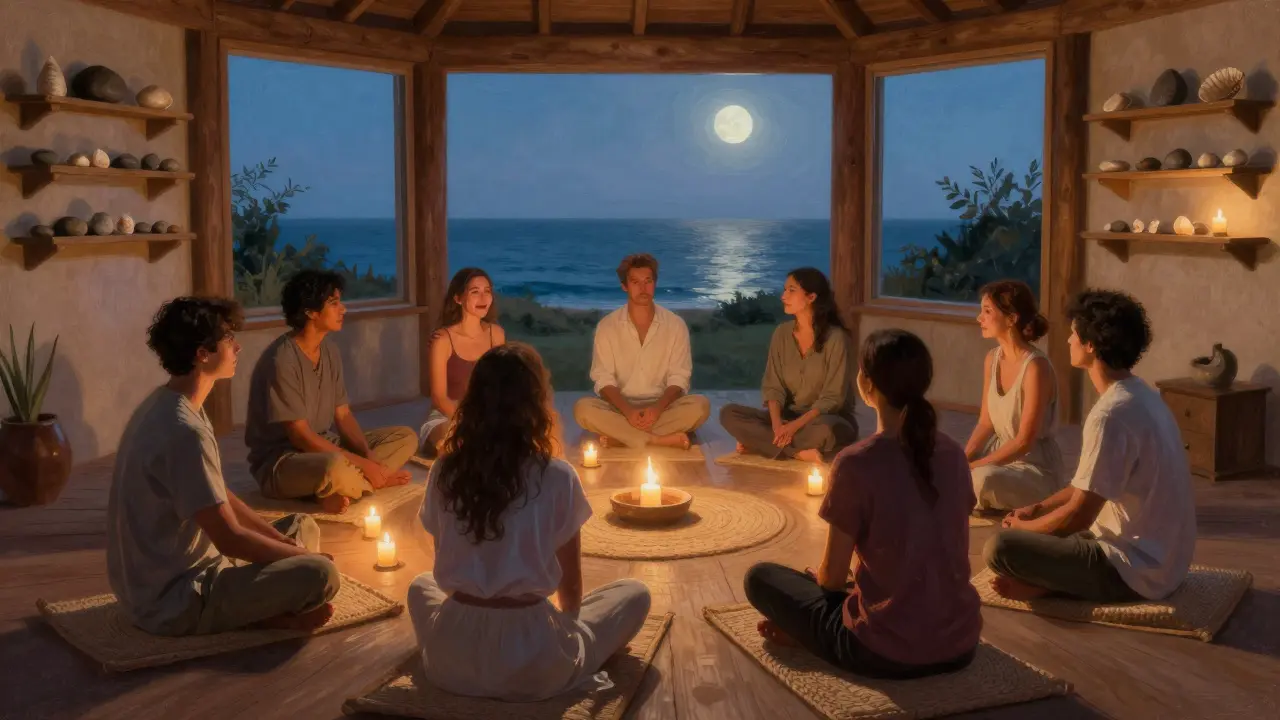
Another came after losing her son. She took part in a ritual called “Grief as a Teacher.” No therapist. No advice. Just a circle of strangers, candles, and silence. She said, “I didn’t get closure. I got company.”
These aren’t therapy sessions. They’re invitations - to feel, to be seen, to let go.
The Philosophy: No Fixes, Just Presence
Esalen doesn’t promise transformation. It doesn’t offer quick fixes. It doesn’t even claim to heal you. What it does is create space - for grief, for rage, for joy, for confusion. It says: You don’t need to be fixed. You need to be witnessed.
This is why Esalen rejects the medical model. There are no diagnoses. No treatment plans. No insurance billing. Instead, there are mirrors - in the form of group work, movement, meditation, and raw conversation. People learn that healing isn’t about fixing what’s broken. It’s about becoming whole in the brokenness.
One of the most powerful tools here is the “encounter group.” No facilitator. No agenda. Just a circle of strangers. Someone starts. Someone else responds. Someone cries. Someone else says nothing. And slowly, without words, people begin to trust. Not because they’re told to. But because they feel safe enough to be themselves.
Who Comes Here - And Why
Esalen doesn’t cater to one kind of person. You’ll find trauma survivors, CEOs, artists, veterans, single parents, and retirees. What they all share? A quiet exhaustion. A sense that something’s missing. Not money. Not status. But depth.
A nurse from Texas came after 18 years in ICU. She said, “I’ve held dying people’s hands. But I never held my own.” She stayed for three weeks. Took a workshop on body awareness. Now she teaches yoga in a prison.
A tech entrepreneur from Silicon Valley came here after a panic attack in his Tesla. He didn’t want to quit his job. He just wanted to stop feeling like a ghost inside his own body. He spent three days in silence. Then he wrote a letter to his team: “I’m stepping back. I’m not broken. I’m just tired.”
Esalen doesn’t ask you to change. It asks you to show up. And that’s enough.

The Ripple Effect
People don’t leave Esalen with a certificate. They leave with a new rhythm. A different way of breathing. A quieter inner voice. A willingness to sit with discomfort instead of numbing it.
Studies from Stanford and UC Berkeley have shown that people who spend even a week at Esalen report lasting drops in cortisol levels - the stress hormone. But the real data? It’s in the stories. The woman who stopped taking antidepressants after a somatic workshop. The man who reconnected with his daughter after a week of honest communication exercises. The teenager who ran away from home - and found his voice in a poetry circle.
Esalen’s impact isn’t measured in numbers. It’s measured in moments. The moment someone says, “I’m not alone.” The moment someone dares to say, “I’m scared.” The moment someone finally lets go.
What Makes Esalen Different Today
It’s 2026. The world is louder than ever. Algorithms feed anxiety. Social media sells perfection. But Esalen? It still has no Wi-Fi in the cabins. No phones during meals. No scheduled routines. You wake when you’re ready. You eat when you’re hungry. You move when you feel like it.
It’s not a luxury retreat. It’s an antidote. To speed. To noise. To performance. To the lie that you need to be more.
Today, Esalen still runs workshops on mindfulness, bodywork, and emotional intelligence. But it also hosts sessions on climate grief, digital detox, and ancestral healing. It’s evolved - not because it chased trends, but because it stayed true to its core: People need to feel human again.
Is Esalen Right for You?
If you’re looking for a quick fix - skip it. If you’re tired of being told what to do - come. If you’ve tried every app, every course, every guru - and still feel empty - this might be the place.
You don’t need to believe in energy healing. You don’t need to meditate. You don’t even need to like group work. You just need to be willing to sit still. To feel. To let someone else see you - without trying to impress them.
Esalen won’t change you. But it might remind you that you’re already whole. You just forgot to notice.
Is Esalen Institute still open today?
Yes, Esalen Institute is still active and open to the public. Located in Big Sur, California, it continues to host workshops, retreats, and overnight stays. While it has modernized some facilities - like adding solar power and updated cabins - it still maintains its core ethos: no Wi-Fi in sleeping areas, no scheduled routines, and a deep commitment to presence over productivity. Reservations are required, and workshops fill up months in advance.
What is the history of Gestalt therapy at Esalen?
Gestalt therapy was developed by Fritz Perls in the 1940s, but it found its most influential home at Esalen in the 1960s. Perls led some of the first public encounter groups there, using techniques like the empty chair and body awareness exercises. These sessions were raw, emotional, and often controversial. What made Esalen unique was that it didn’t treat Gestalt as a clinical method - it treated it as a way of being. People learned to notice their breath, their tension, their unspoken feelings - not to fix them, but to feel them fully. This approach helped shape modern somatic therapy and emotional awareness practices worldwide.
Do you need to be spiritual to benefit from Esalen?
No. While Esalen has roots in spiritual traditions - including Zen, Taoism, and Native American practices - it doesn’t require any belief system. Many attendees are atheists, agnostics, or simply uninterested in spirituality. What matters is openness. Are you willing to sit quietly? To listen? To let yourself feel something you’ve been avoiding? That’s all it takes. The workshops are designed to meet you where you are - not where someone thinks you should be.
How much does it cost to stay at Esalen?
Staying at Esalen varies by program. Overnight stays in a shared cabin start at $120 per night. Workshops range from $500 to $2,500, depending on length and materials. Most include meals and access to the hot springs. Financial aid is available for those who qualify - about 20% of attendees receive partial or full scholarships. The institute operates on a sliding scale model, believing that healing shouldn’t be limited by income.
Can you visit Esalen without joining a workshop?
Yes. Esalen offers a program called "Open Access" - a three-day stay where you can experience the grounds, soak in the hot springs, attend optional meditations, and eat meals in the dining hall. You won’t join a structured workshop, but you’ll still be surrounded by the same energy: quiet, grounded, deeply human. It’s a great way to test the vibe before committing to a longer stay.