
Most of us carry our stress in ways we don't even notice. It’s not just the tight shoulders or the clenched jaw; it’s the shallow breathing, the rigid posture at your desk, and the way you instinctively brace yourself when a deadline looms. We treat stress as a mental problem to be solved with meditation apps or better time management. But what if the root of that tension is physical? What if your body has literally forgotten how to relax?
This is where Feldenkrais training is a method of somatic education that uses gentle movement and directed attention to improve bodily functioning and reduce stress. Developed by Moshe Feldenkrais in the mid-20th century, this approach doesn't ask you to 'push through' pain or 'relax on command.' Instead, it teaches your nervous system new, easier ways to move and breathe. For anyone feeling overwhelmed by modern life, learning to listen to your body might be the most effective stress relief tool you haven't tried yet.
Understanding the Mind-Body Connection in Stress
To understand why Feldenkais works for stress, we first need to look at how stress actually lives in your body. When you face a threat-real or perceived-your sympathetic nervous system kicks into gear. This is the classic fight-or-flight response. Your heart rate spikes, your muscles tense up to prepare for action, and your breathing becomes shallow. In the wild, this makes sense. You run from the predator, the adrenaline burns off, and you return to baseline.
In modern life, however, the 'predator' is usually an email, a traffic jam, or financial worry. You can't run from these things. So, you sit there. Your muscles stay tense. Your breath stays short. Over time, this state becomes your default setting. You aren't just stressed mentally; you are physically stuck in a high-alert mode. This chronic tension restricts blood flow, limits mobility, and keeps your brain in a loop of anxiety. The mind and body are locked in a feedback loop: a tense body signals danger to the brain, which sends more tension back to the body.
Somatic education is the process of learning about one's own body and its patterns through direct experience. Feldenkrais is the leading form of this education. It breaks the cycle by working from the bottom up. By changing the physical input-how you move, how you stand-you change the neurological output. You signal safety to your brain not by thinking calm thoughts, but by embodying them.
The Core Principles of the Feldenkrais Method
Feldenkrais isn't exercise. If you finish a session sweating and exhausted, something went wrong. The method relies on two main formats: Awareness Through Movement (ATM) and Functional Integration (FI). Understanding the difference helps you choose what fits your needs.
- Awareness Through Movement (ATM): These are group lessons where a teacher guides you through a series of gentle movements while you lie down, sit, or stand. You explore variations of common actions like rolling over, standing up, or turning your head. The goal isn't to perform perfectly, but to notice what feels easy and what feels hard.
- Functional Integration (FI): This is a one-on-one session. The practitioner uses gentle touch and verbal cues to guide your awareness. They might support your head while you breathe, or gently move your leg while you focus on your spine. It’s highly personalized and often feels like a deep, active massage combined with cognitive therapy.
The core principle here is differentiation. Most of us move in large, clumsy blocks. To lift a hand, we hike a shoulder. To turn our head, we twist our whole torso. Feldenkrais asks you to break these movements down into tiny increments. By moving slowly and paying close attention, you isolate specific muscles and joints. This precision allows your brain to map your body more accurately. As your internal map improves, your movements become smoother, requiring less effort and generating less stress.

How Gentle Movement Regulates the Nervous System
You might wonder how lying on a mat and wiggling your fingers reduces cortisol levels. The answer lies in neuroplasticity-the brain's ability to rewire itself. Every time you repeat a movement pattern, you strengthen the neural pathways associated with it. If your default pattern is hunching over a keyboard, those pathways are superhighways. The pathways for sitting tall and relaxed are barely dirt roads.
Feldenkrais training builds new roads. By practicing gentle, non-habitual movements, you create new neural connections. This process activates the parasympathetic nervous system-the 'rest and digest' mode. Here is how it works physiologically:
- Reduced Muscle Tension: As you learn to release unnecessary effort, muscle spindles (sensory receptors in muscles) send signals of relaxation to the brain.
- Improved Breathing: Many ATM lessons focus on expanding the ribcage and relaxing the diaphragm. Deep, rhythmic breathing stimulates the vagus nerve, which directly calms the heart rate.
- Sensory Awareness: Paying attention to the contact between your body and the floor grounds you in the present moment. This mindfulness aspect interrupts the ruminative thought loops that fuel anxiety.
It’s not magic; it’s biology. You are teaching your autonomic nervous system that it is safe to let go. Unlike intense cardio, which can sometimes spike stress hormones temporarily, Feldenkrais provides a consistent, low-arousal pathway to calm.
Practical Applications for Daily Stress Relief
You don't need to book a private session every day to benefit from this method. Once you understand the principles, you can apply them anywhere. Here are three practical ways to use Feldenkrais concepts to manage stress in real-time.
1. The Desk Reset
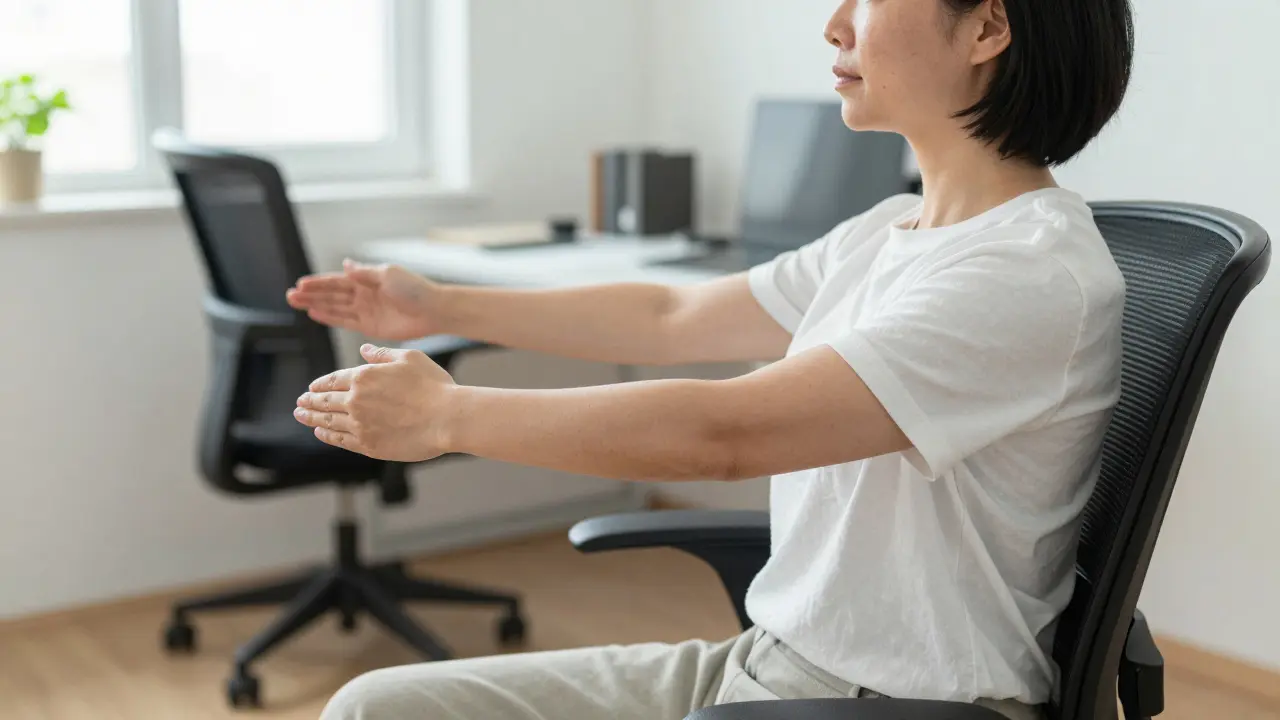
If you work at a computer, you likely spend hours in a static, compressed position. Try this simple ATM-style exploration: Sit on the edge of your chair. Place your feet flat on the floor. Now, imagine your spine is a stack of coins. Can you lengthen the distance between each coin without arching your back? Gently sway side to side, feeling the weight shift from one hip to the other. Notice if you hold your breath. Exhale fully. This takes thirty seconds but resets your proprioception (body awareness) and releases lower back tension.
2. Conscious Walking
Walking is often done on autopilot. Next time you walk, pay attention to the roll of your foot. Do you slap the ground? Do you lock your knees? Try walking as if you are stepping on eggshells, then as if you are marching. Find a middle ground where your legs feel light and your steps are quiet. This mindful movement turns a mundane activity into a meditative practice, lowering stress levels during your commute or lunch break.
3. Sleep Preparation
Insomnia is often a symptom of a nervous system that won't shut off. Before bed, lie on your back with your knees bent. Rock gently from side to side, letting your upper body follow the momentum. Allow your head to flop slightly to one side, then the other. This gentle motion mimics the rocking of infancy, which is naturally soothing. It encourages the release of neck and shoulder tension that accumulates throughout the day, signaling to your brain that it is time to sleep.
Feldenkrais vs. Other Somatic Practices
| Method | Primary Focus | Intensity Level | Best For |
|---|---|---|---|
| Feldenkrais Method | Movement efficiency & neural patterning | Very Low | Chronic tension, postural issues, cognitive stress |
| Yoga | Strength, flexibility, breath control | Low to High | Physical fitness, spiritual grounding, acute stress |
| Alexander Technique | Posture and inhibition of habit | Low | Performers, speech professionals, back pain |
| Massage Therapy | Muscle tissue release | Passive | Acute muscle soreness, immediate relaxation |
While yoga builds strength and flexibility, it can sometimes reinforce existing tensions if not practiced mindfully. Massage treats the symptoms of tension (tight muscles) but doesn't always address the cause (poor movement habits). Feldenkrais sits uniquely in the middle: it is educational rather than therapeutic. You aren't being fixed; you are learning to fix yourself. This empowerment is crucial for long-term stress management because it gives you agency over your physical state.
Getting Started: Finding the Right Approach
If you are interested in trying Feldenkrais, start with an Awareness Through Movement lesson. These are widely available online and in community centers. Look for certified practitioners who emphasize 'ease' and 'awareness' rather than 'correction.' A good teacher will never force you into a position. If it hurts, you stop. The discomfort should be intellectual (thinking hard), not physical.
For deeper work, consider a few sessions of Functional Integration. This is particularly helpful if you have specific areas of chronic pain or trauma stored in the body. However, remember that consistency matters more than intensity. Ten minutes of daily self-exploration using Feldenkrais principles will yield better results than one hour once a month.
Your body is your home. If you neglect its maintenance, the structure suffers. Stress is often just the alarm bell ringing because the house is out of alignment. By tuning into your movement patterns, you don't just reduce stress; you reclaim your comfort, your energy, and your presence in the world.
Is Feldenkrais suitable for people with limited mobility?
Yes, absolutely. Feldenkrais is highly adaptable. Many lessons are performed lying down or sitting in a chair. The movements are small and gentle, making them accessible for elderly individuals, those with disabilities, or people recovering from injury. The focus is on awareness, not range of motion.
How many sessions does it take to see results?
Many people report feeling calmer and more aware after just one Awareness Through Movement lesson. However, lasting changes in stress management and posture typically require consistent practice over several weeks. Think of it like learning a language: you pick up phrases quickly, but fluency takes time.
Can I do Feldenkrais exercises on my own?
Yes. There are numerous books, audio recordings, and video courses available that guide you through ATM lessons. While a teacher provides valuable feedback, self-study is a powerful way to integrate the method into your daily routine.
Does insurance cover Feldenkrais sessions?
Coverage varies widely by provider and location. Since Feldenkrais is often classified as somatic education rather than medical therapy, some health plans may not cover it. However, some chiropractors or physical therapists who are trained in Feldenkrais may bill under their primary license. Always check with your insurer.
Is Feldenkrais different from the Alexander Technique?
Yes, though they share roots. The Alexander Technique focuses heavily on inhibiting habitual reactions and improving posture, often with a strong emphasis on head-neck-back alignment. Feldenkrais focuses more on exploratory movement to discover new, efficient patterns. Both are effective for stress, but Feldenkrais tends to be more playful and investigative.